






【社評雙語道】港完善交通分享更多發展紅利

- 普通話
- 廣東話

- 超大
- 大
- 標準
- 小
原文
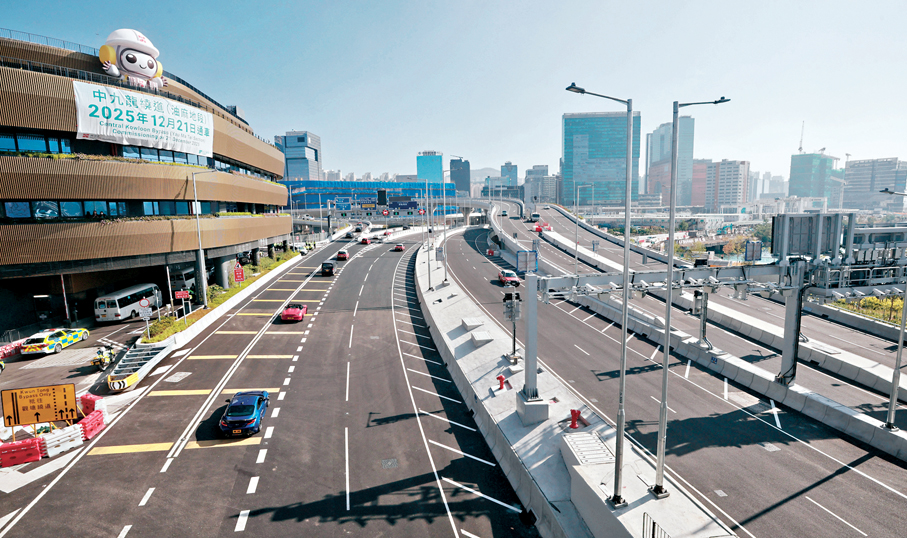
摘錄自2025年12月22日香港《文匯報》:中九龍繞道(油麻地段)12月21日通車,繁忙時段來往啟德至油麻地的車程由以往的30分鐘縮至約5分鐘。完善交通網絡除了有效治理城市交通擠塞痼疾,長遠更有助提升跨境人流、物流運力,強化香港與大灣區其他城市的軟硬聯通,為本港及大灣區經濟社會發展注入強勁動能。社會各界樂見特區政府提速提效做好規劃、推進施工,完善交通基建,讓市民分享更多發展紅利。
中九龍繞道(油麻地段)剛通車,即吸引大批駕駛人士使用。雖然有部分駕駛人士走錯路,但相信經過熟悉路線,加上有關部門迅速改善,解決相關問題並非難事。這項工程最令香港社會自豪的是,施工人員需要在車水馬龍的城市核心地帶進行2,000多次地底爆破以及多個複雜施工工序,同時不影響日常交通運作,不損害地下管線和樓宇結構。管道與港鐵地下路段最近距離只有3米,附近亦有醫院等設施,工程順利完成,證明施工安全通過考驗。
長久以來,東西九龍之間的道路有多個瓶頸存在。亞皆老街有多個交通燈位,阻礙交通暢行;東九龍走廊末段紅磡漆咸道車流與往海底隧道車流交錯,造成壅塞;舊的加士居道天橋「三線併二線、二線併一線」設計限制車流。
至於北部龍翔道則面臨老化問題,路面狀況不理想。中九龍繞道通車後,將為駕駛人士在東西九龍間跨區出行提供便利,減輕塞車之苦。基建硬件是活化經濟的泉源。從更宏觀的粵港澳大灣區建設角度看,完善道路鐵路網絡的「硬聯通」,可以為大灣區「軟聯通」提供基本設施保障與現實基礎,令香港把握及分享內地高速發展機遇。
財政司司長陳茂波在2025年12月21日發表網誌,重申特區政府會繼續按「基建先行、創造容量」的方針,加快落實《香港主要運輸基建發展藍圖》中提出的鐵路、幹道、綠色集體運輸系統項目。其中多個項目,包括中九龍繞道,都是直接或間接聯通港珠澳大橋、深圳灣、皇崗等口岸,長遠為提升粵港澳跨境人流物流運力提供助力,有利香港對接國家高質量發展。
特區政府近日宣布邀請港鐵開展詳細規劃及設計南港島線(西段)。早年通車的由金鐘通往鴨脷洲的南港島線,令途經的黃竹坑一帶由傳統工業區化身成新興商貿區。南港島線(西段)的建成,相信也可為香港仔這個仍主要靠路面交通出入的地區,營造新的面貌,旅客從內地來港,未來只需從邊境轉乘一兩程鐵路,一小時左右就可抵達香港仔遊覽,激活更多南區旅遊資源,創造經濟收益。
同樣,擬建跨境鐵路中,比較矚目的北環線支線,將令深圳與新界西北的元朗和屯門的距離更近,更為重要的是,對接新開發的北部都會區,為跨境通勤、商貿帶來便利,進一步消除兩地隔閡,促進互聯互通,彰顯大灣區是具有中國式現代化特質的國際一流灣區。
現時鄰近香港的深圳、廣州等大灣區主要城市,基建發展一日千里,城市面貌日新月異。香港宜追趕大灣區其他城市發展進度,在確保安全和服務可靠的前提下,壓縮規劃和興建時間,把握時機打通香港交通根脈,讓香港更好地融入大灣區「一小時生活圈」。
譯文
Enhancing Speed and Efficiency to Improve Transport and Share More Development Benefits
The Central Kowloon Bypass (Yau Ma Tei Section) opened to traffic on 21 December, reducing the journey time between Kai Tak and Yau Ma Tei during peak hours from 30 minutes to approximately 5 minutes. Enhancing the transport network not only effectively addresses chronic urban congestion but also, in the long term, boosts cross-border passenger and freight flows. It strengthens both the soft and hard connectivity between Hong Kong and other cities in the Greater Bay Area, injecting robust momentum into the economic and social development of both Hong Kong and the Greater Bay Area. All sectors of society welcome the Government's efforts to accelerate and improve planning, advance construction, and enhance transport infrastructure, enabling citizens to share more development dividends.
The newly opened Yau Ma Tei section of the Central Kowloon Bypass has immediately attracted a large number of drivers. Although some drivers initially took wrong turns, it is believed that familiarisation with the route, coupled with prompt improvements by relevant authorities, will readily resolve any issues. What makes this project a source of pride for Hong Kong is that workers had to carry out more than 2,000 underground blasting operations and multiple complex construction procedures in the heart of a bustling city, all without disrupting daily traffic, damaging underground pipelines, or compromising building structures. The tunnel runs as close as three metres to MTR underground sections, and nearby facilities include hospitals. The successful completion of the project proves that safety standards have passed the test.
For a long time, there have been several bottlenecks on roads between East and West Kowloon. Argyle Street has multiple traffic lights that hinder smooth flow; at the end of the East Kowloon Corridor, traffic from Chatham Road in Hung Hom intersects with vehicles heading to the Cross-Harbour Tunnel, causing congestion; and the old Gascoigne Road Flyover's design of "three lanes merging into two, then two into one" limits traffic capacity.
Meanwhile, Lung Cheung Road in the north faces ageing issues and poor road conditions. With the opening of the Central Kowloon Bypass, drivers will find it easier to travel across districts between East and West Kowloon, alleviating the pain of traffic jams. Infrastructure is the lifeblood of economic revitalisation. From the broader perspective of Greater Bay Area development, improving road and rail networks—the "hard connectivity"—provides the essential foundation for "soft connectivity" within the region, enabling Hong Kong to seize and share the opportunities brought by the Mainland's rapid development.
Financial Secretary Paul Chan reiterated in his blog that the Government will continue to follow the infrastructure-led and capacity-creating approach, to expedite the implementation of railway, trunk road and green mass transit projects outlined in the Hong Kong Major Transport Infrastructure Development Blueprint. Several projects, including the Central Kowloon Bypass, directly or indirectly connect to ports such as the Hong Kong-Zhuhai-Macao Bridge, Shenzhen Bay, and Huanggang. These will enhance cross-border passenger and freight capacity between Guangdong, Hong Kong, and Macao in the long term, facilitating Hong Kong's integration into the nation's high-quality development.
The Government recently announced its invitation to MTR Corporation to commence detailed planning and design for the South Island Line (Western Section). The earlier section of the South Island Line, connecting Admiralty to Ap Lei Chau, has transformed the surrounding Wong Chuk Hang area from a traditional industrial zone into an emerging commercial and business district. The completion of the South Island Line (Western Section) is expected to similarly revitalise Aberdeen, an area currently reliant on road transport. Visitors from the Mainland will be able to reach Aberdeen for sightseeing within approximately one hour by transferring to one or two rail services from the border. This will activate more tourism resources in the Southern District and generate economic benefits.
Similarly, among the proposed cross-border railways, the highly anticipated Northern Link Spur Line will significantly reduce travel times between Shenzhen and Yuen Long/Tuen Mun in Northwest New Territories. More crucially, it will connect to the newly developed Northern Metropolis, facilitating cross-border commuting and commerce. This will further bridge the divide between the two regions, enhance connectivity, and demonstrate the Greater Bay Area's status as a world-class bay area embodying the characteristics of Chinese-style modernisation.
Currently, major cities in the Greater Bay Area adjacent to Hong Kong, such as Shenzhen and Guangzhou, are witnessing rapid infrastructure development and transformative urban landscapes. Hong Kong should strive to catch up with the development pace of other cities in the Greater Bay Area. While ensuring safety and service reliability, it should compress planning and construction timelines to seize the opportunity to establish Hong Kong's transport arteries. This will enable Hong Kong to better integrate into the Greater Bay Area's 'one-hour living circle'.
●Tiffany
 0
已點過讚
0
已點過讚





評論(0)
0 / 255